
Why Donor Cultivation Matters
Fundraising isn’t simply a matter of finding a potential donor and asking for a gift. The relationships that support scholarships, capital campaigns, community programs, and other important initiatives are built through meaningful interactions, relevant engagement, and consistent follow-up.
A structured donor cultivation process gives your advancement team a way to approach these relationships with intention. It helps staff understand where each relationship stands, identify opportunities for engagement, and ensure important interactions and follow-ups are not overlooked.
This guide explains the donor cultivation cycle, explores its seven stages, and outlines how schools and nonprofits can put the process into practice.
What Is the Donor Cultivation Cycle?
The donor cultivation cycle is the ongoing process of building and strengthening relationships with individuals and organizations that may support your school or nonprofit. It involves understanding their interests, developing their connection to your mission, and making an appropriate request for support when the time is right.
The process continues after a gift is made. Acknowledgment, communication, and stewardship help donors understand the impact of their contributions and remain connected to your organization. This ongoing engagement can create opportunities for future support and involvement.
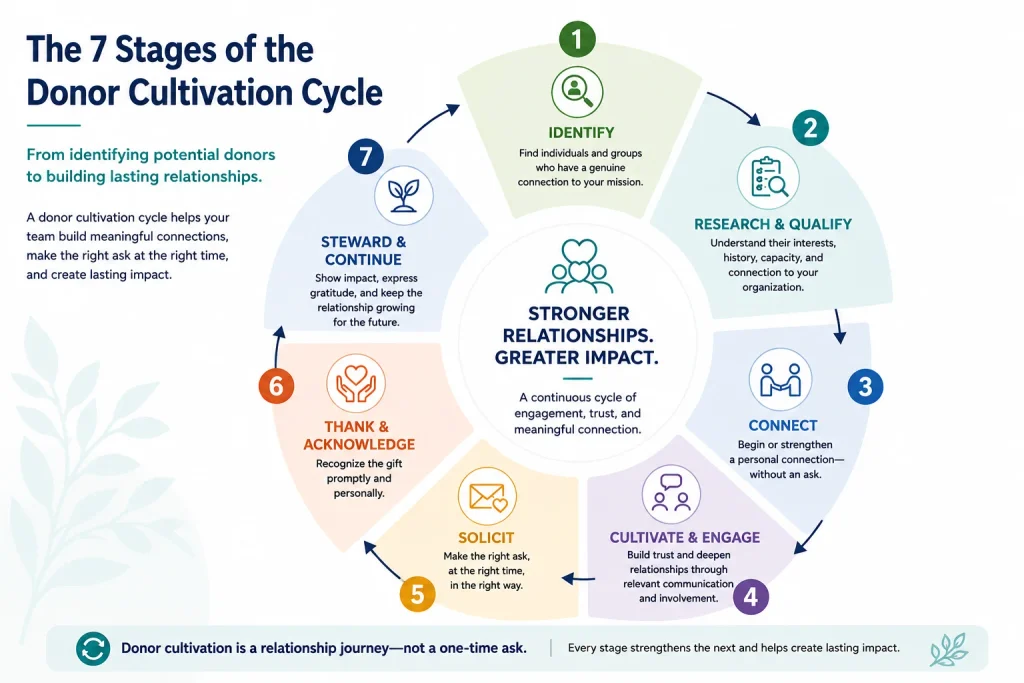
The 7 Stages of the Donor Cultivation Cycle
The donor cultivation cycle generally follows seven stages:
- Identify potential donors.
- Research and qualify prospective donors.
- Establish an initial connection.
- Cultivate and engage donors.
- Make an appropriate request for support.
- Thank and acknowledge donors.
- Steward donors and continue the relationship.
Although these stages provide a useful structure, donor relationships do not always develop in a fixed sequence. A new prospect may require several months of engagement before being ready to consider a contribution. An existing donor, on the other hand, may already have an established relationship with the organization and be ready for a conversation about a new campaign.
Development teams should therefore use the cycle as a guide rather than a rigid process. The objective is to understand where each relationship stands and determine the most appropriate next step.
The Seven Stages
Stage 1: Identify Potential Donors
Donor cultivation begins with identifying individuals and organizations that could become supporters of your school or nonprofit. These prospects may already have a connection to your organization or may have shown an interest in the work you do.
For schools, potential donors often include alumni, current and former parents, grandparents, board members, and local businesses. Nonprofits may find prospects among volunteers, event participants, corporate partners, previous supporters, and individuals who have engaged with their programs.
The goal at this stage is to build an initial pool of potential supporters. Development teams can start by reviewing existing contact lists, event registrations, volunteer records, and previous fundraising participation. They can also consider people who have expressed interest in a particular school program or nonprofit initiative.
For example, a school preparing to launch a new scholarship campaign might identify alumni, former parents, and community members who have previously participated in student support initiatives. These individuals provide a starting point for further research and engagement.
At this stage, the team is simply identifying people who could have a meaningful connection to the organization’s mission. Decisions about their giving potential and the best way to approach them come later in the process.
Stage 2: Research and Qualify Prospective Donors
Once a list of potential donors has been created, development teams need to determine which individuals to prioritize and how best to approach them. This involves gathering information about their interests, previous involvement, giving history, and relationship with the organization.
Start by reviewing available donor records. Has the individual contributed before? Have they supported a particular campaign or program? Do they regularly attend fundraising events or participate in school activities? These details can help reveal their interests and level of involvement.
Teams can also consider an individual’s capacity and willingness to give. For example, a former parent who has consistently supported the school’s annual fund may be a strong prospect for another school-wide initiative. Someone who has regularly volunteered but has never made a financial contribution may be more interested in participating in a specific program before considering a gift.
Research should also identify existing relationships that could help facilitate an introduction. An alumnus who maintains contact with a former school administrator, for instance, may be more receptive to hearing from that individual than receiving an unsolicited fundraising email.
The outcome of this stage should be a clearer understanding of which prospects deserve attention, what they care about, and how the development team should approach them. This allows staff to prioritize their time rather than treating every contact as an immediate fundraising opportunity.
Stage 3: Establish an Initial Connection
After identifying and researching suitable prospects, the next step is to make contact. The purpose of this interaction is to introduce or reconnect the individual with the organization and create an opportunity for further communication.
The approach will depend on the prospect’s existing relationship with the school or nonprofit. For someone who already knows the organization, an email sharing recent developments or a personal invitation to an upcoming event may be appropriate. For someone with a less established connection, an introduction from a board member, school leader, or mutual contact may be a better starting point.
Consider a school reaching out to an alumnus who graduated several years ago but has not been involved recently. Rather than immediately asking for a contribution, the development team could share an update about recent campus developments, invite the alumnus to an upcoming reunion, or introduce them to a current school initiative.
The first interaction should give the individual a reason to reconnect and an opportunity to learn more about the organization’s current work. It should also help the team understand whether the prospect is interested in continuing the conversation.
Not every initial contact will receive a response, and some individuals may not be interested in further involvement. Development teams should record these outcomes and respect the prospect’s communication preferences when deciding whether another interaction is appropriate.
Stage 4: Cultivate and Engage Donors
Once an initial connection has been established, the focus shifts to developing the relationship. This stage involves giving prospective donors meaningful opportunities to learn about the organization, understand its priorities, and become more involved in its activities.
The most effective engagement is based on what the individual has already expressed an interest in. For example, if an alumnus has shown an interest in student scholarships, the development team could share updates about financial assistance programs, introduce them to the staff responsible for those initiatives, or invite them to an event where they can learn about the program’s impact.
Other engagement opportunities may include campus visits, meetings with school leadership, invitations to fundraising events, program updates, and opportunities to meet individuals involved in the organization’s work.
The team should also pay attention to how prospects respond to these interactions. Do they ask questions about a particular initiative? Do they attend events or request additional information? Have they expressed interest in learning about the organization’s future plans? These responses can help the team understand which areas are most relevant to the individual.
Communication should remain consistent, but it should not become a series of repeated donation requests. The purpose is to build familiarity and confidence in the organization’s work before presenting an opportunity to contribute.
By the end of this stage, development teams should have a better understanding of the prospect’s interests, concerns, and willingness to support the organization. This information helps determine whether the time is right to make a fundraising request.
Stage 5: Make an Appropriate Request for Support
After developing the relationship and understanding the prospect’s interests, the development team can move toward making a specific request for support. This stage is known as solicitation.
A fundraising request should connect the donor’s interests with an identified need or opportunity within the organization. Instead of sending a general appeal, explain what the organization is trying to accomplish, why support is needed, and how the contribution could help achieve the intended outcome.
For example, a school that has spent time engaging an alumnus around student financial assistance might introduce its scholarship fund and explain how contributions help make education accessible to more students. Similarly, a nonprofit could approach a longtime supporter about funding a specific community program they have previously shown interest in.
The request should also be clear about the type of support being sought. Depending on the campaign, this may involve a suggested contribution amount, a pledge, sponsorship, or support for a particular project. For larger fundraising initiatives, the development team may also provide a proposal outlining the campaign’s objectives and expected impact.
It is important to consider who should make the request and how it should be delivered. A development director may lead the conversation, while a head of school, board member, or another individual with an established relationship may help present the opportunity.
Not every request will result in an immediate contribution. Some prospects may agree to give, while others may need more time, request additional information, or decline. The development team should document the response and agree on the appropriate next step rather than automatically scheduling another request.
Stage 6: Thank and Acknowledge Donors
Once a donor contributes, the organization should acknowledge the gift promptly. This is an important part of the donor experience because it confirms that the contribution has been received and communicates that the donor’s support is valued.
A timely acknowledgment should recognize the specific contribution, the campaign or fund it supports, and the difference the donor is helping make. While an automated receipt can confirm the transaction and provide necessary records, a personal thank-you message from the development team or school leadership can make the interaction more meaningful.
For example, when a parent contributes to a school’s annual fund, the acknowledgment could include a personal message from the head of school thanking them for supporting the institution’s priorities. For a major gift supporting a new facility, the school might arrange a personal call or meeting to express its appreciation.
Organizations should also ensure that acknowledgments reflect donor preferences. Some individuals may be comfortable with public recognition in newsletters or annual reports, while others may prefer to remain anonymous. These preferences should be recorded and respected.
The immediate goal of this stage is to make sure every contribution receives an appropriate acknowledgment. A donor should not have to wonder whether their gift was received or whether the organization recognizes their support.
Stage 7: Steward Donors and Continue the Relationship
After acknowledging a contribution, the organization should continue communicating with the donor and showing how their support is being used. Donor stewardship focuses on keeping supporters informed about the organization’s progress and demonstrating the outcomes their contributions help make possible.
For schools, this could involve sharing updates about scholarship recipients, improvements to campus facilities, or the progress of a program supported by donor contributions. Nonprofits might communicate project milestones, program results, or updates about the communities benefiting from their work.
For example, if a donor contributed to a school’s scholarship fund, the development team could provide an update on the number of students receiving financial assistance or share a story about the opportunities the program has created. This helps connect the original contribution to a tangible outcome.
Stewardship also involves maintaining communication outside fundraising campaigns. Invitations to school events, annual impact reports, personal updates from organizational leaders, and opportunities to participate in programs can all help donors remain connected.
Development teams should keep track of these interactions, including the information shared, the donor’s responses, and any interests or concerns raised during conversations. This creates a useful record for future engagement and helps staff understand how the relationship is developing.
Over time, these efforts may lead to renewed contributions, participation in other campaigns, or introductions to new supporters. Some donors may choose to continue supporting the same initiative, while others may become interested in different areas of the organization’s work. By staying informed about donor interests and keeping communication relevant, development teams can maintain relationships beyond individual campaigns.
From Understanding the Cycle to Building a Plan
Understanding the seven stages is a useful starting point, but development teams also need a practical way to apply them across their donor relationships. A donor cultivation plan helps translate the overall strategy into specific activities, responsibilities, and follow-up actions.
Begin by identifying the donors and prospects who require focused attention. These may include individuals who have recently demonstrated interest, longtime supporters who could be introduced to a new initiative, or prospective donors with an established connection to the organization’s mission.
Next, determine where each relationship currently stands in the cultivation cycle. A new prospect who has only attended one event will require a different approach from a donor who has supported the organization for several years. Understanding this distinction helps teams avoid making requests before a relationship is ready.
Once the current stage has been established, identify a meaningful next action. This could involve sharing a relevant update, arranging a personal introduction, inviting the individual to an event, or preparing a fundraising conversation. Each action should have a clear purpose and reflect what the team already knows about the donor.
Responsibility for these interactions should also be clearly assigned. When multiple staff members are involved in fundraising, it is important to establish who will manage the relationship, coordinate communication, and complete outstanding follow-ups. This prevents repeated outreach and ensures that important conversations are not overlooked.
For schools and nonprofits that are beginning to formalize their cultivation process, starting with 10 to 15 priority donor relationships can be a practical approach. The team can identify each person’s current stage, agree on the next action, and assign responsibility for following through. Once this process is established, it can gradually be extended to a larger group of prospects and supporters.
Why Tracking Donor Relationships Matters
A donor cultivation plan is only useful when the information behind it is accessible and up to date. Development teams need a consistent way to record donor interests, giving history, previous conversations, communication preferences, and planned follow-ups.
This becomes particularly challenging as the number of donor relationships grows. Staff may have to refer to email conversations, individual spreadsheets, meeting notes, and personal reminders to understand what has happened with a particular donor. When information is spread across different locations, team members may miss important details or approach someone without knowing about a previous conversation.
A centralized donor management system helps bring this information together. Team members can review a donor’s giving history, communication records, interests, and previous interactions in one place. They can also document the current cultivation stage and next planned activity, making it easier for colleagues to understand the status of each relationship.
This is especially valuable when responsibilities change or several team members are involved in fundraising activities. A shared record provides continuity and helps ensure that donors receive consistent communication, regardless of who is managing the next interaction.
Keeping these records current also helps development teams review their progress. They can see which relationships need further engagement, identify follow-ups that are due, and make informed decisions about where to focus their time.
Schools can also use our school fundraising checklist to review donor records, acknowledgment processes, stewardship responsibilities, and other important fundraising activities.
Bring Your Donor Cultivation Process Together
A well-defined donor cultivation strategy helps schools and nonprofit organizations approach fundraising with greater consistency and purpose. From identifying potential supporters to maintaining relationships after a contribution, each stage gives development teams a clearer way to understand donor interests and plan meaningful engagement.
Putting this process into practice requires a reliable way to manage donor information, review previous interactions, monitor campaigns, and keep track of upcoming activities. When these details are accessible to the team, staff can coordinate their efforts and maintain a clearer view of each donor relationship.
FundThrive by MentisSoft helps advancement teams at private K–12 schools and nonprofit organizations manage donor information, giving history, interactions, campaigns, and follow-ups in one place. By keeping these details accessible, FundThrive helps teams maintain relationship records, coordinate fundraising activities, and stay informed about the progress of donor relationships.
As donor management software for nonprofits, FundThrive gives teams a clearer way to track relationships and manage the activities that support long-term donor engagement.
See how FundThrive can support your donor cultivation process.