
Why Donor Cultivation Matters
Fundraising isn’t simply a matter of finding a potential donor and asking for a gift. The relationships that hold up over years — the ones that fund scholarships, capital campaigns, and everything in between — are built through a series of meaningful interactions, relevant engagement, and consistent follow-up, long before and long after any single ask.
A structured donor cultivation process gives your advancement team a way to approach these relationships with intention, so important opportunities and interactions don’t get lost between one person’s memory and the next person’s inbox.
This guide walks through that process: understanding the donor cultivation cycle, working through each of its seven stages, and turning what you learn into a plan your team can run.
What Is the Donor Cultivation Cycle?
The donor cultivation cycle is the ongoing process of building and strengthening relationships with people who may support your school or nonprofit organization. It involves understanding their interests, keeping them engaged, and making the right ask when the time is appropriate.
The relationship doesn’t end once a gift is made. Continued communication, appreciation, and stewardship help keep donors connected to your organization and can lead to future support — making cultivation an ongoing cycle rather than a one-time process.
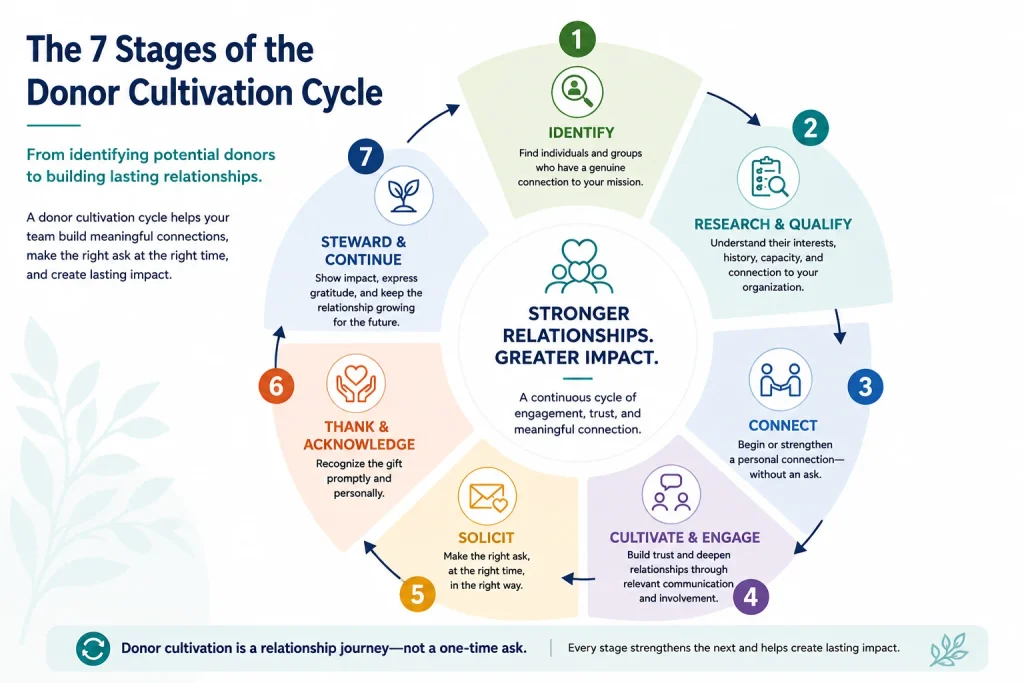
The 7 Stages of the Donor Cultivation Cycle
1. Identify → 2. Research & Qualify → 3. Connect → 4. Cultivate & Engage → 5. Solicit → 6. Thank & Acknowledge → 7. Steward & Continue the Relationship → back into cultivation
This framework is useful, but donor relationships rarely move through it in a straight line. Some people spend a long time cultivating before they’re ready for an ask. Others move backward — from solicitation into deeper cultivation — if the timing wasn’t right. A longtime donor might skip straight from identification to solicitation because the relationship already exists in another form.
Treat the seven stages as a map, not a script. What matters is knowing where a given relationship actually stands, and what the next right step is from there.
The Seven Stages
Stage 1: Identify Potential Donors
What This Stage Means
Finding the individuals and groups who are most likely to have a genuine interest in, or connection to, your school’s mission — before any outreach begins.
Why It Matters
Not every name in your database deserves the same level of attention. Identifying the right prospects means your team’s time goes toward relationships that have a real chance of developing, instead of being spread thin across everyone.
Key Actions
- Start with people who already have a connection to the school — alumni, current families, grandparents, former faculty
- Look for signs of existing interest: event attendance, volunteering, past giving at any level
- Note any known capacity indicators, without treating capacity as the only filter
Your Checklist
- Pull a list of alumni, current families, and community members with an existing connection
- Flag anyone who’s attended an event, volunteered, or engaged in the past 12 months
- Note any known capacity or wealth indicators, where available
- Cross-check against current donors to avoid duplicating outreach
- Rank the list by likely affinity first, capacity second
Stage 2: Research and Qualify
What This Stage Means
Understanding a prospective donor before deciding how and whether to approach them.
Why It Matters
The more relevant an interaction is, the more likely it is to lead somewhere. Reaching out without doing this work first usually just produces a generic message the recipient can spot immediately.
Key Actions
- Review their history with the school and their giving record, if any
- Understand their connection point — alum, parent, board member, community partner
- Note their interests, and who else at the school or in your donor community they’re connected to
- Confirm how they prefer to be contacted
Your Checklist
- Review giving history and past event attendance
- Note their connection point to the school
- Identify shared interests or causes they’ve supported elsewhere
- Confirm preferred contact method
- Check for existing relationships — staff, board members, or other donors who know them
Stage 3: Connect
What This Stage Means
Beginning or strengthening a personal connection, without leading with an ask.
Why It Matters
Donor cultivation shouldn’t open with a request for support. The earliest interactions are where trust gets established; skip that step and everything after it is harder to build on.
Key Actions
- Choose a low-pressure reason to reach out: an event invite, a school update, a warm introduction
- Reference something specific to them, not a template
- Keep this first touchpoint ask-free, on purpose
Your Checklist
- Identify the most natural first point of contact for this person
- Personalize the outreach — reference their specific connection to the school
- Confirm the interaction has no ask attached
- Set a reminder to follow up within two to three weeks
Stage 4: Cultivate and Engage
What This Stage Means
Moving past the first interaction and continuing to build the relationship over time — through communication, invitations, and shared experience.
Why It Matters
This is where a nonprofit organization or school demonstrates that a donor relationship is about more than a single transaction. It’s also the stage most programs underinvest in, and often the reason a donor who seemed promising quietly goes cold.
Key Actions
- Share relevant communication and updates, not a mass newsletter blast
- Invite them to events that genuinely match their interests
- Offer a specific, low-commitment way to get more involved
- Record every interaction so momentum doesn’t depend on one person remembering
Your Checklist
- Add the donor to relevant (not all) communications
- Invite them to at least one event or gathering this year
- Share a specific story or update tied to their interests
- Offer one low-commitment way to get more involved
- Log the interaction so the next person to reach out isn’t starting from zero
Stage 5: Solicit
What This Stage Means
Making a clear, relevant, and appropriately timed request for support.
Why It Matters
An ask should feel like the natural next step in an existing relationship — not an isolated interaction that arrives out of nowhere. Get the timing wrong, and even a well-crafted ask can set the relationship back.
Key Actions
- Confirm the relationship has had real engagement before this point
- Match the ask to something this donor has shown interest in
- Decide who should make the ask, and prepare them with context
- Plan for a yes, a no, and a maybe
Your Checklist
- Confirm the relationship has had at least two prior non-ask touchpoints
- Match the ask to a program or purpose this donor cares about
- Decide who should make the ask, and brief them
- Choose a setting and timing appropriate to the size of the ask
- Prepare a follow-up plan for every possible response
Stage 6: Thank and Acknowledge
What This Stage Means
Recognizing the donor and their gift promptly, personally, and appropriately.
Why It Matters
What a donor experiences in the days right after giving shapes how they feel about the relationship going forward — often more than the ask itself did.
Key Actions
- Acknowledge the gift quickly, not weeks later
- Personalize the message instead of sending a form letter
- Confirm recognition preferences before publishing a donor’s name
- Be clear about how the gift will be used
Your Checklist
- Send a personal thank-you within 48 hours
- Reference the specific gift and its purpose
- Confirm recognition preferences before any public acknowledgement
- Follow up with how the gift is being used, once there’s something concrete to share
Stage 7: Steward and Continue the Relationship
What This Stage Means
Maintaining the relationship after the gift and helping the donor see the impact of their support over time.
Why It Matters
A contribution shouldn’t mark the end of the relationship — it’s where the next cycle quietly begins. A donor who’s stewarded well often returns to Stage 1 far more invested than they were the first time around.
Key Actions
- Report on the impact of the gift, more than once
- Keep the donor on relevant communications going forward
- Look for the next natural opportunity for involvement
- Keep the relationship history up to date, so it’s usable by the whole team
Your Checklist
- Share a follow-up update on impact within 3–6 months
- Keep the donor on relevant communications going forward
- Look for the next appropriate touchpoint or involvement opportunity
- Reassess where they now sit in the cycle
This is where the cycle comes full circle — stewardship done well flows directly back into cultivation.
From Understanding the Cycle to Building a Plan
Knowing the seven stages is useful. Applying them consistently across dozens, or hundreds, of donor relationships is a different challenge, and it’s where most teams need more than good intentions.
A donor cultivation plan comes down to five practical elements:
1. Identify Priority Donors — Who should receive focused attention right now?
2. Determine Their Current Stage — Where does this relationship actually stand in the cycle?
3. Define the Next Action — What specifically should happen next?
4. Assign Responsibility — Who owns this interaction or follow-up?
5. Track Progress — What’s already happened, and what’s still outstanding?
Run this for your top 10–15 relationships before trying to scale it further. A plan your team follows for a handful of donors is worth more than a system that looks good on paper, but nobody uses.
Why Tracking the Donor Journey Matters
As the number of donor relationships grows, it gets harder to keep track of the basics: previous interactions, donor interests, giving history, current cultivation stage, planned follow-ups, next steps.
A structured process is most effective when your team has a consistent way to record and access the information that guides each relationship — not scattered across individual inboxes, sticky notes, and one person’s memory of “who that donor’s kid is.” This is usually less of a strategy problem than it looks like, and more of a tracking problem: the plan was right, but nobody could see it in one place.
Your Donor Cultivation Action Plan
Before you close this out, work through this list honestly:
- Review your current donor cultivation process
- Identify where your team is already performing well
- Identify stages where relationships tend to lose momentum
- Define your priority donors and prospects
- Determine the current stage for each priority relationship
- Identify the next meaningful action for each donor
- Assign responsibility for follow-up
- Establish a consistent process for recording interactions and next steps
- Review and update donor cultivation plans on a regular schedule
If a few of these gave you pause, that’s exactly what this checklist is for.
Bring Your Donor Cultivation Process Together
A clear donor cultivation strategy is only as effective as your team’s ability to put it into practice, consistently, across every relationship.
FundThrive helps advancement teams at private K–12 schools and nonprofit organizations keep donor information, giving history, interactions, campaigns, and follow-ups in one place — so every relationship stays visible, no matter who’s managing it or how many donors are in cultivation at once.
As donor management software for nonprofits, FundThrive gives teams a clearer way to track relationships and manage the activities that support long-term donor engagement.
See how FundThrive can support your donor cultivation process.